


By Chris Audet, Vice President and Chief of Research, Gartner Assurance Practice
Now more than ever, compliance and privacy leaders face mounting pressure to maintain structures while navigating the constraints of available resources. Despite the current volume and volatility of the regulatory landscape and a growing mandate to safeguard structures in recent years, compliance functions must still demonstrate their value with limited resources.
Benchmarking the core components of the compliance function is especially useful for such purposes. Three critical compliance attributes to measure are compliance allocation of funds, compliance technology adoption, and compliance staffing and role allocation. By examining past trends and accounting for the volatile regulatory environment, among other emerging risks, compliance leaders can better gauge the organization’s needs as 2025 progresses.
Below are the trends Gartner experts have observed with their compliance function benchmarking.
Compliance budgets and allocation of funds
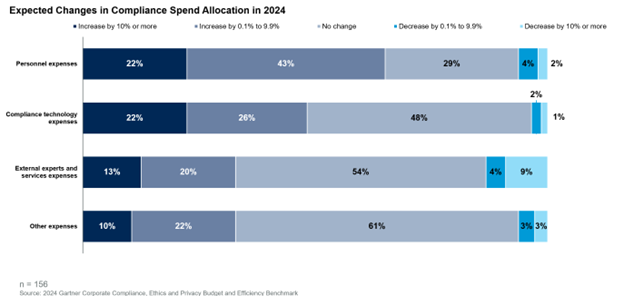
Overall, compliance resourcing has remained flat between 2022 and 2024, with many compliance leaders never recovering resources lost amid COVID-19 budget cuts. Total compliance and ethics spend per 1,000 employees, which includes operational expenses, has hovered around $150K the last three years (Figure 1).
Given that compliance spend has remained flat for several years, this represents a reduction in real terms given inflation. This is reflected in anticipated budgetary allocations with the majority of organizations benchmarked by Gartner expecting a flat or declining budget allocation in all categories except personnel expenses (see Figure 1.) With fewer resources and staff and an increasingly complex regulatory landscape, compliance leaders need to understand and assess spending, utilization, budgets and ownership of different resources while keeping watch on the right ownership of activities.
Figure 1: Expected Changes in Compliance Budget Allocation in 2024
Compliance technology and adoption
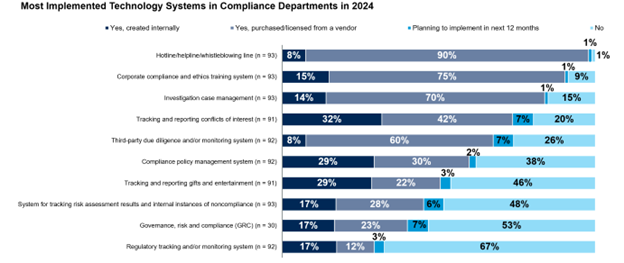
Last year, 46% of organizations forecasted some increase in compliance technology expenses. Given the current regulatory volatility and trade-disruption led growth in the use of third parties, Gartner experts expect to see sustained interest in compliance risk management technology, including Governance, Risk and Compliance (GRC), third-party risk management (TPRM), and regulatory intelligence tools, given their relatively low rates of adoption (see Figure 2.) compared to other compliance tools and the current environment compliance teams are facing.
Figure 2: Compliance Technology Adoption in 2024
Compliance staffing and role allocation
Despite assumed increases in employee headcount after the COVID-19 budgeting stagnation, increased staffing did not occur. Total compliance staff per 1,000 employees has also declined, from 0.66 per 1,000 employees in 2022 to 0.6 projected for 2025. In addition, compliance teams are now a median of seven FTEs, down from eight three years ago.
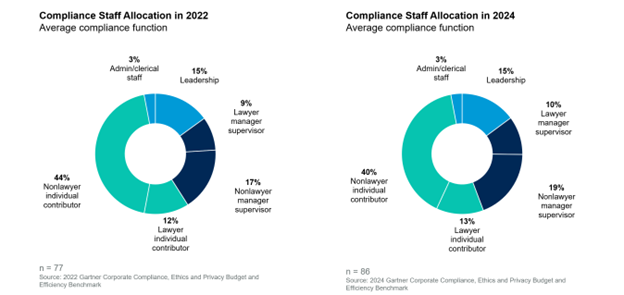
Of the expected changes in compliance staff positions, the increase in nonlawyer individual contributor decreased the most, falling from 44% in 2022, to 40% in 2024. The changes in dedicated roles for compliance staff changed the most for third-party risk management, increasing from 43% in 2022 to 51% in 2024 (see figure 3.)
Figure 4: Compliance staffing allocation
While the findings for compliance budgets overall may not paint an optimistic picture, this insight can guide leaders in optimizing their operations amid constrained budgets.