


By Wilson Masih
Artificial intelligence is moving rapidly from experimentation into the operational core of modern enterprises. Financial institutions deploy machine learning to detect fraud. Retail companies use predictive models for pricing and personalization. Healthcare systems rely on algorithmic tools to support diagnostics and patient triage. As AI adoption accelerates, a new question is emerging inside organizations: who is responsible for governing these systems?
In many companies, the answer increasingly points toward the corporate compliance function. Compliance leaders are accustomed to overseeing areas such as anti-corruption programs, data protection, and internal controls. AI introduces a new category of operational risk that shares characteristics with each of these domains. It can influence decisions affecting customers, employees, and regulators. It can expose organizations to reputational harm if deployed carelessly. And it often operates in ways that are difficult to audit without deliberate oversight.
For these reasons, many organizations are now treating AI governance as a natural extension of their compliance programs.
The challenge, however, is that most compliance teams were not originally built to oversee machine learning models or automated decision systems. What they need is a practical framework that translates AI governance into familiar compliance practices.
This article outlines a simple playbook that compliance teams can use to begin operationalizing AI oversight within their organizations.
Why AI Has Become a Compliance Issue
Artificial intelligence introduces a new class of risk because it affects how decisions are made inside organizations. When algorithms influence lending approvals, hiring recommendations, insurance underwriting, or customer targeting, the compliance implications become significant.
Three factors in particular explain why AI governance is now on the compliance agenda.
Regulatory expectations are expanding
Regulators worldwide are beginning to scrutinize AI systems more closely. Frameworks such as the EU Artificial Intelligence Act and the NIST AI Risk Management Framework are shaping expectations around transparency, risk classification, and oversight.
Algorithmic decisions can create compliance exposure
If an automated system produces biased outcomes or relies on improperly governed data, the organization may face discrimination claims, privacy violations, or reputational damage.
Operational complexity obscures accountability
AI systems are rarely built by a single team. Data scientists, engineers, product managers, and business units all contribute. Without clear governance structures, it can become difficult to determine who owns the risk.
These dynamics mean that AI governance increasingly resembles other compliance domains: it requires policies, controls, documentation, and ongoing monitoring.
Three AI Risks Compliance Leaders Should Understand
Before designing controls, compliance teams should understand the primary risk areas associated with enterprise AI deployments.
1. Data Governance Risk
AI models depend on large volumes of training data. If that data includes sensitive personal information, inaccurate records, or unapproved data sources, it can introduce privacy and regulatory risks. Compliance teams must ensure that data used for training and inference adheres to existing governance policies.
2. Model Transparency and Explainability
Many advanced models operate as complex statistical systems that are difficult to interpret. When these models influence high-impact decisions, organizations must be able to explain how those decisions were produced. Regulators increasingly expect organizations to demonstrate this level of transparency.
3. Operational Monitoring Risk
Even well-designed models can degrade over time. Changes in customer behavior, market conditions, or data patterns may cause performance to drift. Continuous monitoring is necessary to ensure that models remain accurate and compliant.
Recognizing these risks allows compliance programs to apply familiar oversight practices to a new technological context.
A Practical Framework for AI Governance
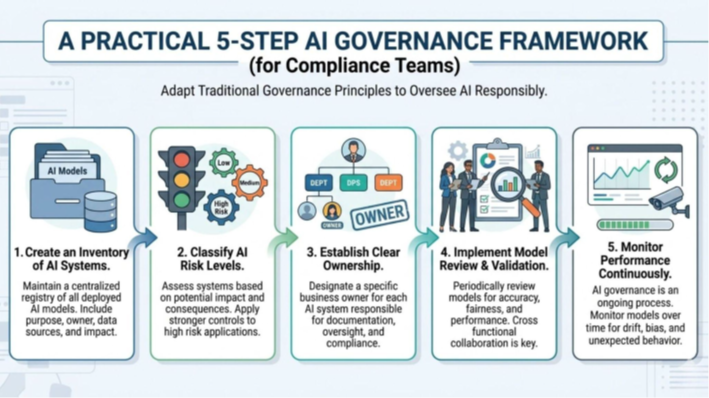
Compliance teams do not need to become machine learning experts to oversee AI responsibly. Instead, they can adapt traditional governance principles to AI systems. A practical starting framework includes five steps.
Step 1: Create an Inventory of AI Systems
Organizations should maintain a centralized registry of all AI models deployed in production environments. This registry should include information such as each model’s purpose, responsible owners, data sources, and decision impacts. An AI inventory provides the same function as other compliance registers: it ensures visibility and accountability.
Step 2: Classify AI Risk Levels
Not all AI systems carry equal risk. A model that recommends product content may require less oversight than a model influencing credit decisions or hiring recommendations. Compliance teams should classify systems based on potential impact and apply stronger governance controls to high-risk applications.
Step 3: Establish Clear Ownership
Every AI system should have a designated business owner responsible for governance, documentation, and oversight. This ensures that compliance questions can be directed to accountable stakeholders rather than disappearing into technical teams.
Step 4: Implement Model Review and Validation
High-impact models should undergo periodic review to assess accuracy, fairness, and operational performance. This review process often involves collaboration between data science teams, risk management functions, and compliance leaders.
Step 5: Monitor Performance Continuously
AI governance is not a one-time exercise. Organizations should monitor model performance over time and investigate anomalies that may signal drift, bias, or unexpected behavior.
This framework allows compliance teams to apply familiar control principles to the governance of AI technologies.
How Compliance Programs Can Begin Today
Many organizations assume AI governance requires extensive technical infrastructure before meaningful oversight can begin. In practice, compliance teams can take several immediate steps.
- Initiate a cross-functional discussion with technology leaders to understand where AI systems are currently used across the enterprise.
- Develop a basic AI inventory documenting models and automated decision systems already in production.
- Incorporate AI considerations into existing risk assessments and audit programs. Questions about training data, monitoring practices, and model documentation can be integrated into standard compliance reviews.
- Monitor emerging regulatory expectations. The regulatory landscape for AI is evolving rapidly, and compliance programs must remain attentive to new frameworks and guidance.
Organizations that take these early steps position themselves to manage AI adoption responsibly while continuing to benefit from its operational advantages.
The Expanding Role of Compliance in the AI Era
Artificial intelligence will continue to reshape how organizations operate. Yet as AI systems become more influential in business decisions, the need for strong governance will only grow.
Corporate compliance functions are uniquely positioned to guide this transition. They bring experience in risk management, policy enforcement, and organizational accountability. By extending these principles to AI oversight, compliance leaders can help ensure that technological innovation proceeds responsibly.
Rather than viewing AI as purely a technical domain, organizations should recognize it as a governance challenge that intersects with ethics, regulation, and operational risk.
When compliance programs take an active role in AI governance, they help build the trust and accountability necessary for organizations to deploy these powerful technologies with confidence.
About the Author
Wilson Masih is a digital marketing strategist at Samta.ai, a company focused on enterprise AI governance and responsible AI deployment. He writes about AI risk management, compliance frameworks, and enterprise AI transformation. For organizations exploring structured approaches to AI governance and enterprise risk management, additional resources discussing practical governance frameworks can be found at the Samta.ai AI Risk Management resource.